What Is a Mill Test Report? Steel Plate Buyer’s Guide
World crude steel production for the 70 countries reporting to the World Steel Association was 139.6 million tonnes in December 2025. That is a massive amount of metal moving across borders, into warehouses, and onto shop floors. Amid all those millions of tonnes, how does a buyer verify that the steel plate sitting on the truck actually matches the order?
You cannot visually confirm a yield strength. You cannot look at a plate edge and see its carbon equivalent. For buyers, the primary tool for this check is the mill test report.
Why Documentation Matters When Buying Steel Plate
A purchase order specifies a grade, a thickness, and a standard. That is the easy part. The harder part happens after the truck arrives. Without proof of quality, a buyer has nothing but a supplier’s word. In critical applications, a word is not enough.
Documentation gives you something to hold the material against. You need to know whether the plate meets the required chemistry, was tested for tensile strength, and complies with ASTM or ASME standards. No documentation means no traceability. And no traceability means you own every risk that comes with that piece of steel.
What Is a Mill Test Report?
A mill test report is a quality assurance document. It records what the steel is made of and how it performs under mechanical stress. For steel plate buyers, it confirms the chemistry, mechanical properties, traceability, and compliance with standards.
Some suppliers call it a Certified Mill Test Report. Others say Mill Certification, Metallurgical Test Report, or Mill Test Certificate. Regardless of the name, the critical part is whether the document contains actual test data from the original production heat, not just a statement of compliance.
Who Issues a Mill Test Report?
So, who issues a mill test report? The report is typically issued by the producing steel mill where the steel was melted, cast, rolled, and tested. Because the mill performs chemical assays and mechanical testing during production, it is the only entity qualified to certify the heat's initial properties.
Once the steel leaves the mill, this documentation is passed along the supply chain to the service center or distributor, and finally to the end buyer. While a supplier might provide the document, the "source of truth" remains the producing mill, and the report should identify the producing mill and be certified or authorized by its quality department.
What Information Is Included in a Mill Test Report?
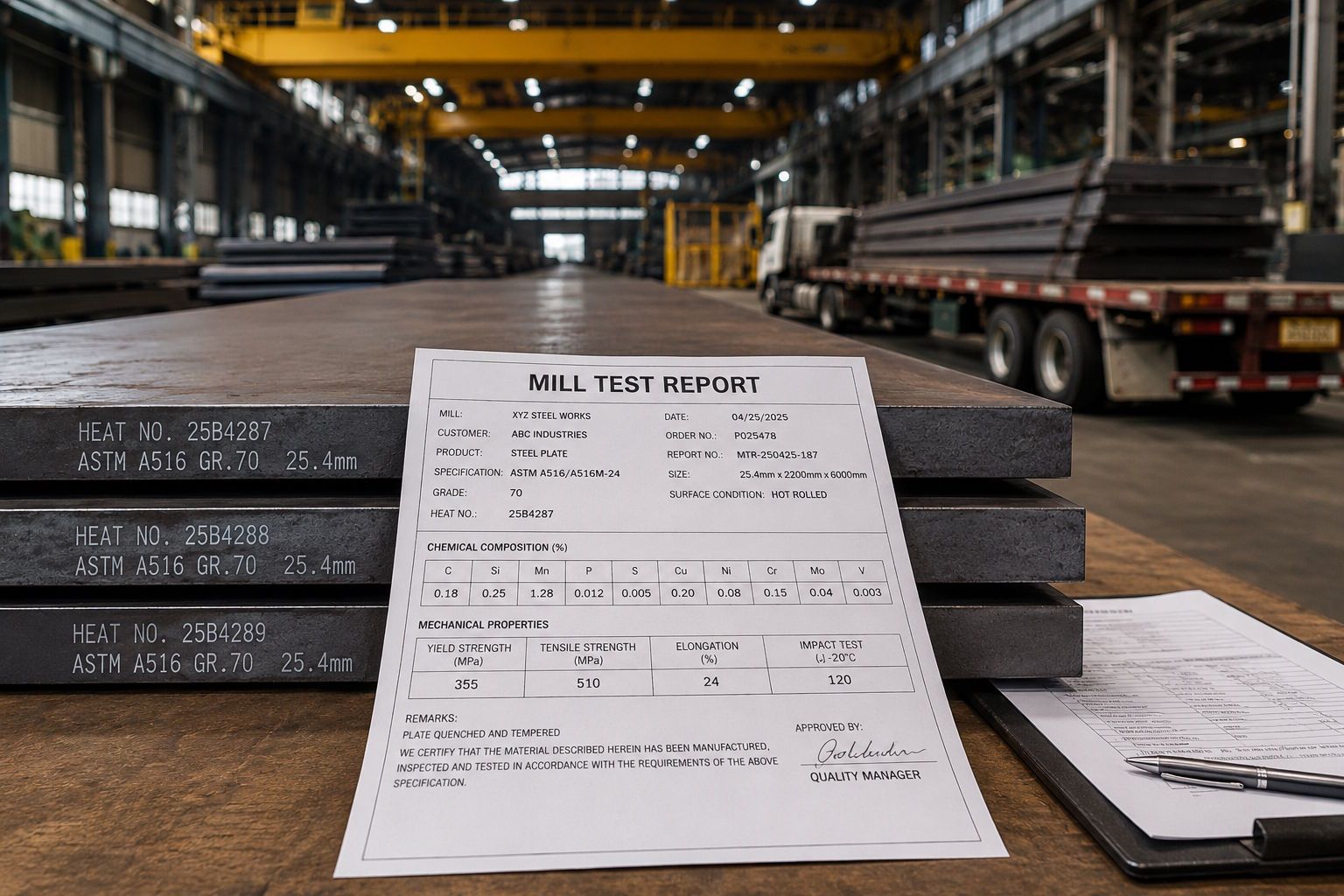
A complete mill test report for steel contains several distinct categories. A buyer who knows where to look can assess a material’s suitability in a few minutes. A buyer who does not might miss a red flag until it is too late.
Heat Number and Traceability
The heat number is a unique identifier for a specific production batch. You will find it stamped or written on the plate itself. The same number appears on the report. Matching these two confirms that the paperwork belongs to that exact piece of steel. Without that match, the mill test report is useless. Traceability prevents grade mix-ups and helps isolate problems if a heat turns out to have off-chemistry or poor mechanical performance.
Chemical Composition
This section lists the elements in the steel by percentage. For carbon steel, carbon, manganese, phosphorus, sulfur, and sometimes silicon and copper appear here. For stainless grades, chromium and nickel are critical. The values must fall within the ranges allowed by the relevant specification. A carbon level that is too high affects weldability. Sulfur that is out of spec affects toughness.
Mechanical Properties
Here you will find tensile strength, yield strength, and elongation. For certain applications, hardness values or Charpy V-notch impact test results may also appear. Yield strength tells you where the steel begins to deform permanently. Tensile strength tells you its ultimate breaking point. If those numbers do not meet the required standard, the plate is not fit for the intended service.
Grade, Specification, and Standards
The report will state the material grade, such as ASTM A516 Grade 70 or 316L. It will also reference the specific standard edition year. For pressure vessel work, ASME compliance is often required. A buyer should verify that the grade and specification on the MTR exactly match the purchase order.
Product Details and Dimensions
Mill test reports describe the product form: plate, sheet, bar, or structural shape. For a steel plate, the thickness, width, and length should be listed. This information helps confirm that the MTR covers the specific pieces delivered. If a supplier gives you one MTR for a whole skid of plate, make sure the dimensions and piece counts line up.
Why Mill Test Reports Matter for Steel Plate Buyers
Now that the meaning of a mill test report is clear, why does this record matter? For starters, it is a tool that serves three practical functions for any buyer who wants to avoid costly surprises.
Quality Assurance
The MTR confirms that the plate meets the specified properties. It is documented evidence, not a sales claim. When you receive a plate with a matching MTR, you have documented test data from the producing mill, not just a supplier’s claim. That is the difference between hoping the material works and knowing it will.
Compliance and Inspection
Third-party inspectors and code authorities expect to see MTRs. No MTR, no approval. For any regulated project, whether pressure vessels, structural steel for public infrastructure, or ASME-stamped equipment, the documentation is part of the deliverable. Without it, the material might not exist as far as the inspector is concerned.
Material Traceability
Traceability protects you after fabrication. If a weld cracks or a vessel leaks, the heat number on the mill test report lets you trace every piece from that same batch. You can isolate the problem and take corrective action without guessing. If you skipped the MTR or lost it, a single failure puts every piece of unverified plate in question.
How to Read a Mill Test Report for Steel Plate
Do not just file the MTR away. Take two minutes and run through a quick review. First, compare the MTR directly against your purchase order. Does the grade match? The specification? What about the dimensions?
Second, walk to the plate and find the stamped heat number. Does it match the heat number on the report? If not, stop. Third, examine the measured values for chemistry and mechanical properties. Do they fall within the required specification ranges? Finally, flag anything missing. Mill test reports without a heat number, a signature, or incomplete test data are not valid documents.
Mill Test Report vs Certificate of Compliance
A Certificate of Compliance is a general statement from a supplier that the material meets certain standards. It has no actual test data. A mill test report contains the measured values for that specific heat.
The table below breaks down the key differences side by side:
| Feature | Mill Test Report | Certificate of Compliance |
|---|---|---|
| Contains actual test data | Yes. Lists measured chemical composition and mechanical properties. | No. Only a statement that the material meets the standard. |
| Traceability | Yes. Includes a specific heat number linked to the physical plate. | Typically, no heat number. No direct link to a production batch. |
| Accepted for code work | Yes. Required for ASME, ASTM, and most regulated projects. | No. Does not satisfy code inspection requirements. |
| Typical use case | Pressure vessels, structural steel, sanitary processing, aerospace. | Low risk, non-code, or decorative applications. |
| Issued by | The producing mill is based on actual heat analysis. | The supplier or distributor often has no mill test backing. |
When Do Steel Plate Buyers Need a Mill Test Report?
Whenever the consequences of material failure are significant, you need a mill test report. Structural steel, pressure vessel plate, boiler quality material, and any component subject to code inspection all require traceable documentation. Infrastructure projects under DOT oversight will demand it.
Sanitary processing equipment for food or pharmaceutical use also requires full material traceability. If a failed component could harm someone, shut down a facility, or trigger a lawsuit, request the MTR before releasing the material for fabrication.
Common Mistakes Buyers Make With Mill Test Reports
One big mistake is checking only the grade and ignoring the heat number. A plate can be correctly marked Grade 316, but if the heat number on the plate does not match the MTR, you have a mismatch.
Another common error is assuming that because a document has an ASTM number on top, the test results automatically meet that standard. They do not. You have to check the numbers. A third mistake is failing to keep MTRs on file. Years after a project finishes, an owner might ask for documentation. If you did not save it, you cannot go back and ask the mill for a replacement on a ten-year-old heat.
Conclusion: Why Mill Test Reports Are Worth Reviewing
Skipping the mill test report review is a short-term time saver that can turn into a long-term liability. The report tells you what the steel actually contains, how it behaves under load, and where it came from. That information is the difference between building with confidence and hoping nothing fails. Take the few minutes required to match the heat number, check the data, and file the document. That small habit pays for itself the first time a problem does not happen because you caught it early.
FAQ
Recent Posts
Hot Rolled vs Cold Rolled Steel Plate: What’s the Difference
Plasma Cutting vs Laser Cutting: Which Is Better for Steel Plate
Common Industrial Uses of Steel Plate in Modern Fabrication
Abrasion Resistant Steel Plates: Grades, Properties, and Applications